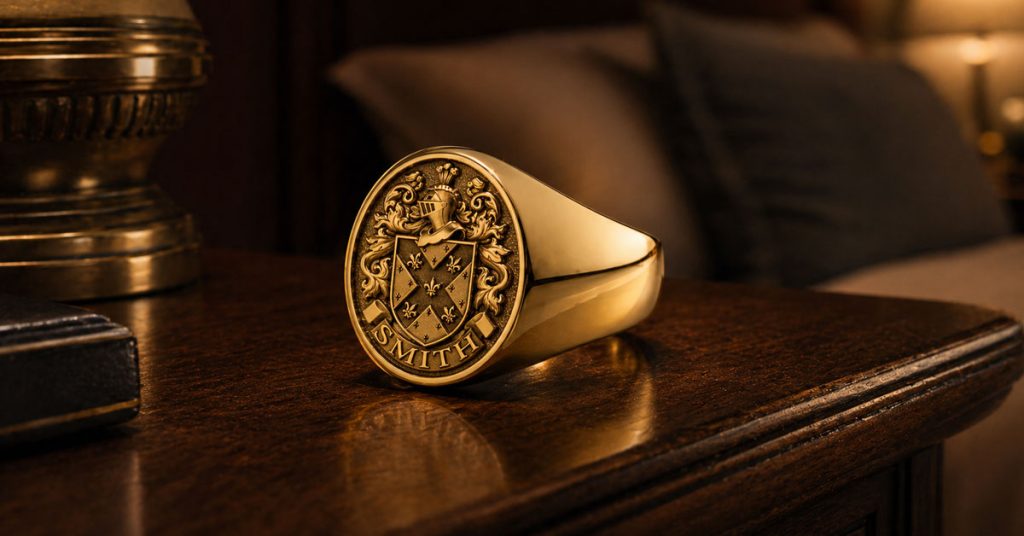
SMITH, Family Crest Rings
SMITH, Family Crest Rings are custom rings featuring heraldic symbols associated with the Smith surname, one of the most common names in English-speaking countries.
These rings represent family identity, history, and tradition, often customized in style, engraving method, and metal to reflect personal meaning.
Why SMITH Family Crest Rings Are So Popular
The surname “Smith” is not rare—it’s the opposite. In fact, it ranks as one of the most common last names in the United States and beyond. That popularity creates a unique situation.
Because the name is so widespread, multiple heraldic interpretations exist. Therefore, no single “official” Smith crest applies to everyone. Instead, designs are drawn from historical variations tied to regions, lineages, and recorded arms.
As a result, buyers should approach these rings with a practical mindset. You’re not just buying a symbol—you’re selecting a representation that aligns with your identity, not a one-size-fits-all emblem.
SMITH Family Crest Ring Styles Compared
| Style Type | Description | Visual Effect | Best For |
|---|
| Raised Traditional | Crest raised above surface | Bold, high contrast | Classic, statement look |
| New Traditional | Crest engraved into surface | Clean, modern detail | Everyday wear |
| Old Traditional | Reversed engraving (seal style) | Functional stamping | Historical authenticity |
| Oval Shape | Fully rounded face | Soft, traditional | Timeless style |
| Antique Shape | Rectangular with rounded corners | Structured, vintage | Strong visual presence |
| Polished Finish | Smooth, reflective surface | High shine | Formal appearance |
| Engraved Finish | Textured detailing | Subtle contrast | Added depth |
| Pendant Option | Crest worn as necklace | Flexible styling | Non-ring preference |
Understanding Raised vs Engraved Crest Designs
This is where most buyers make mistakes.
Raised designs place the crest above the surface. That makes the details stand out immediately. However, they are more exposed to wear over time.
Engraved designs cut the crest into the metal. Because of this, they tend to hold detail longer with daily use. Additionally, they offer a cleaner and more modern appearance.
Old Traditional styles go further. They reverse the image so the ring can create a wax seal. Meanwhile, New Traditional styles show the crest in correct orientation but do not function as a stamp.
So the real question becomes: do you want visual impact or historical function?
Choosing the Right Shape: Oval vs Antique
Shape affects more than appearance—it changes how the ring feels and wears.
Oval designs are smooth and balanced. Therefore, they suit most hands and feel familiar. In contrast, Antique styles introduce sharper structure with softened corners. This gives a more vintage and bold look.
If subtlety matters, go oval. However, if you want presence, Antique styles tend to stand out more.
Metal Choices: What Actually Matters Long-Term
Many buyers focus on looks first. That’s a mistake.
Material determines durability, maintenance, and long-term value. For example, non-precious alloys offer affordability but limited lifespan. Meanwhile, gold and sterling silver provide better longevity and resale value.
Manufacturing also matters. A ring made from raw materials and finished by hand will outperform mass-produced alternatives.
That’s why companies like Dunham Jewelry Manufacturing, Inc. emphasize in-house production and material transparency. They source high-purity gold and control the entire process, which directly impacts durability and consistency .
Why Customization Is More Important Than the Crest Itself
Here’s the part most guides ignore.
The crest alone does not make the ring meaningful. Personalization does.
You can adjust engraving, finish, shape, and even symbolism. Therefore, the final piece reflects your story—not just a historical reference.
Additionally, customization ensures the ring doesn’t feel generic. That matters, especially with a surname as common as Smith.
Direct manufacturers typically allow deeper customization because they control production. This eliminates the limitations found in retail-only models.
How SMITH Crest Rings Are Actually Made
Not all rings are built the same way.
Mass-produced rings prioritize speed. As a result, details can look soft, and structures may feel hollow.
In contrast, individually crafted rings focus on precision. Each engraving is sharper, and the structure is more solid.
For example, handcrafted production allows better stone setting, cleaner polish, and stronger build quality .
So the question becomes practical: do you want a ring that looks good today, or one that holds up for decades?
What Most Buyers Get Wrong
Several patterns show up repeatedly:
First, many assume there is one “correct” Smith crest. That’s not accurate. Multiple variations exist.
Second, buyers often prioritize price over construction. However, cheaper rings typically sacrifice durability.
Third, people underestimate wear. Raised designs look impressive, but engraved styles often last longer with daily use.
Understanding these trade-offs helps avoid regret later.
Should You Choose a Ring or a Pendant?
Not everyone wants a ring—and that’s fine.
Pendants offer flexibility. You can wear them occasionally without worrying about daily wear. Meanwhile, rings carry stronger symbolic presence and visibility.
If you want constant representation, choose a ring. However, if you prefer versatility, a pendant may be the better option.
Final Thought: What Actually Makes a SMITH Crest Ring Worth It
It’s not the name. It’s not even the crest.
Value comes from three things:
- Construction quality
- Material integrity
- Personal meaning
Without those, it’s just another accessory.
With them, it becomes something you keep for life.