Design a Custom University Ring Online
Designing a university ring online sounds simple. However, most buyers underestimate what actually matters.
At first glance, many online tools look similar. Yet, the difference lies in control, materials, and manufacturing quality. Therefore, choosing the right process determines whether your ring lasts decades—or wears out quickly.
Most importantly, customization is not just about appearance. It directly affects durability, meaning, and long-term value.
| Feature | True Custom Ring (Manufacturer) | Retail Template Ring |
|---|---|---|
| Design Control | Full customization | Limited presets |
| Material Transparency | Clearly defined | Often unclear |
| Manufacturing | Individually handcrafted | Mass-produced |
| Pricing Structure | Direct pricing | Retail markup |
| Longevity | Built for lifetime wear | Shorter lifespan |
| Engraving Detail | Sharp and precise | Simplified |
Why Designing Online Is Better Than Buying Pre-Made
Traditional jewelry stores rely on inventory. As a result, customization is limited.
Online design tools change that completely. You can choose every detail before the ring is made. Therefore, the final product reflects your identity—not a generic template.
Additionally, online customization allows real-time decisions. You can compare metals, adjust engraving, and test designs instantly. This reduces guesswork.
However, not all online systems are equal. Some only simulate customization while still producing mass-market rings.
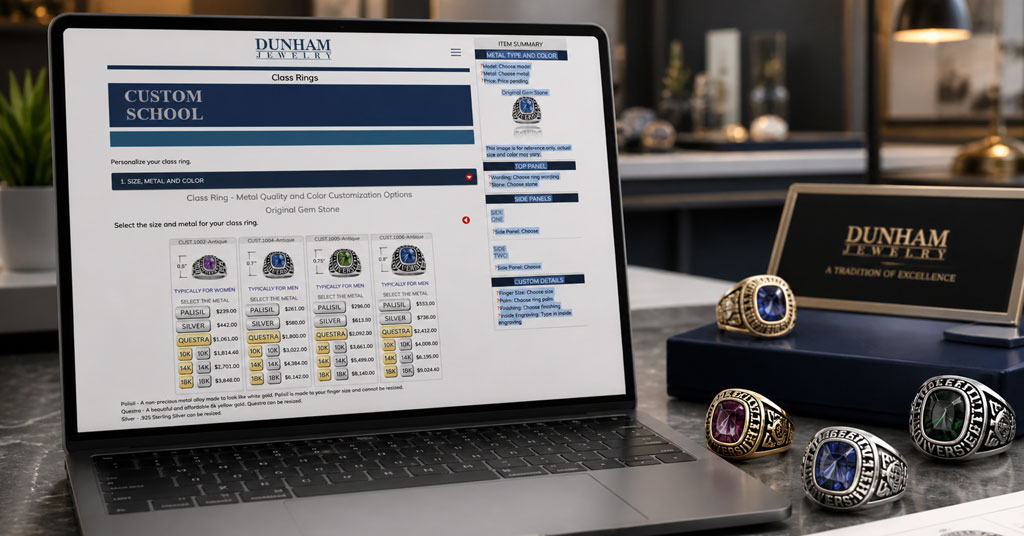
The Step-by-Step Process to Design Your Ring
The process is straightforward. Yet, each step carries long-term impact.
Step 1: Choose Your Model
Start with the overall ring style. This defines structure, size, and layout.
Step 2: Select Metal Type
Metal affects durability, price, and maintenance. For example, gold lasts longer, while alloys reduce cost.
Step 3: Pick Your Stone
The center stone adds identity. Birthstones and school colors are common choices.
Step 4: Customize Side Panels
This is where personalization becomes meaningful. Add mascots, majors, or achievements.
Step 5: Add Engraving
Inside engraving turns the ring into something personal. Names, dates, or short messages are typical.
Step 6: Final Fit and Finish
Ring size, polish, and finishing details determine comfort and appearance.
Each step builds toward a final piece that reflects both identity and craftsmanship.
Material Choice: The Most Overlooked Decision
Most buyers focus on design first. That’s a mistake.
Material determines how the ring performs over time. Therefore, it should be your first priority.
- Alloys like Palisil offer durability at lower cost
- Sterling silver provides a classic appearance
- Gold options deliver long-term value and strength
Additionally, material transparency matters. Many sellers do not clearly explain what you are buying.
In contrast, direct manufacturers control alloying and sourcing. This ensures consistency and compliance with standards.
Customization vs Templates: What You’re Really Getting
Many companies advertise “custom rings.” However, most rely on templates.
Template systems limit creativity. You choose from preset options rather than true customization.
In contrast, real customization allows:
- Unique engraving placement
- Fully personalized side panels
- Flexible material choices
- Individual manufacturing
As a result, the final ring feels intentional—not mass-produced.
Why Manufacturing Control Matters
This is where most buyers get it wrong.
Retailers do not make rings. They outsource production. Therefore, quality varies.
A direct manufacturer controls:
- Design accuracy
- Material integrity
- Finishing quality
- Structural strength
Moreover, handcrafted production improves detail and durability. Each ring is built individually rather than produced in bulk.
Cost Breakdown: What You’re Actually Paying For
Price differences can be confusing. However, they usually come down to structure.
Retail pricing includes markups. Manufacturing pricing does not.
Key cost drivers include:
- Metal type
- Stone selection
- Design complexity
- Labor and finishing
Therefore, a lower price is not always a better value. It often means compromises in material or construction.
How to Make the Right Design Decisions
Good design is not about adding everything. It is about choosing what matters.
Start with purpose. Ask:
- What does this ring represent?
- Will it be worn daily?
- Does durability matter more than cost?
Then prioritize:
- Material first
- Structure second
- Details last
This approach prevents overdesign and ensures long-term satisfaction.
What Makes a Ring Worth Keeping for Life
A university ring is not disposable jewelry.
It represents years of effort, identity, and achievement. Therefore, it should last physically and emotionally.
High-quality rings share three traits:
- Strong materials
- Precise craftsmanship
- Meaningful customization
Additionally, lifetime guarantees reflect manufacturing confidence—not marketing.
When a company controls production, it can stand behind its work.