How to Find Your Family Coat of Arms and Preserve Your Family Legacy
Family Coat of Arms Research at a Glance
| Step | What to Do | Why It Matters |
|---|---|---|
| Build Your Family Tree | Trace paternal ancestry | Arms traditionally pass through family lines |
| Identify Locations | Find ancestral towns and countries | Heraldic laws vary by region |
| Search Historical Records | Verify individuals and family connections | Prevents false assumptions |
| Consult Heraldic Authorities | Check official registries | Confirms legitimacy |
| Avoid Surname Databases | Verify before purchasing | Many sites sell generic designs |
| Consider Personal Arms | Create a unique design if no arms exist | Establish your own legacy |
What Is a Family Coat of Arms?
A coat of arms is a unique heraldic design originally granted to an individual by an authorized heraldic authority. These designs often included:
- Shields
- Crests
- Helmets
- Mottos
- Supporters
- Heraldic symbols
Historically, coats of arms identified individuals on battlefields, legal documents, and official seals. Over time, they became symbols of family heritage and social identity.
Today, many people use coats of arms to celebrate ancestry through family crest rings, pendants, artwork, and genealogy projects.
The Biggest Myth About Family Coats of Arms
One of the most common misconceptions is that every surname has a family coat of arms.
However, heraldry does not work that way.
A coat of arms belongs to a specific person and their lawful descendants. Therefore, two people sharing the same surname may have completely different family histories and no legitimate connection to the same heraldic design.
This misunderstanding has created a large market for generic “surname coat of arms” products that often have no genealogical connection to the buyer.
Understanding this distinction can save significant time, money, and disappointment.
Step 1: Build Your Family Tree
The first step is genealogical research.
Begin by collecting information from:
- Birth certificates
- Marriage records
- Death certificates
- Census records
- Immigration records
- Family Bibles
- Historical photographs
Additionally, speak with older relatives whenever possible. Personal stories often reveal valuable clues that formal records miss.
Focus especially on your paternal line because many historical heraldic traditions passed arms from father to son.
Popular genealogy resources include:
- FamilySearch
- MyHeritage
- Ancestry
- FindMyPast
The more generations you document, the easier it becomes to connect your lineage to historical records.
Step 2: Identify Your Ancestral Homeland
After building your family tree, determine where your ancestors lived.
This step matters because heraldic traditions vary significantly across regions.
England
Coats of arms were granted and regulated by heraldic authorities. Arms were inherited under strict rules.
Scotland
Scottish heraldry remains one of the most regulated systems in the world. Arms are protected under legal authority.
Ireland
Irish heraldic traditions are maintained through official records and genealogical documentation.
Germany and Switzerland
Unlike Britain, many non-noble citizens registered family arms. Consequently, research often extends beyond noble lineages.
United States
There is no government authority regulating personal coats of arms. Therefore, individuals may legally assume their own designs.
Step 3: Search Official Heraldic Records
Once you identify a likely ancestral location, search official heraldic sources.
Reliable authorities include:
- College of Arms for England, Wales, and Northern Ireland
- Court of the Lord Lyon for Scotland
- Office of the Chief Herald of Ireland
- Regional European archives
- Historical armorial collections
Official records provide substantially more credibility than commercial surname databases.
Furthermore, they often contain supporting documentation that can verify family relationships.
Step 4: Examine Family Heirlooms
Many families already possess clues without realizing it.
Look for:
- Signet rings
- Family crest rings
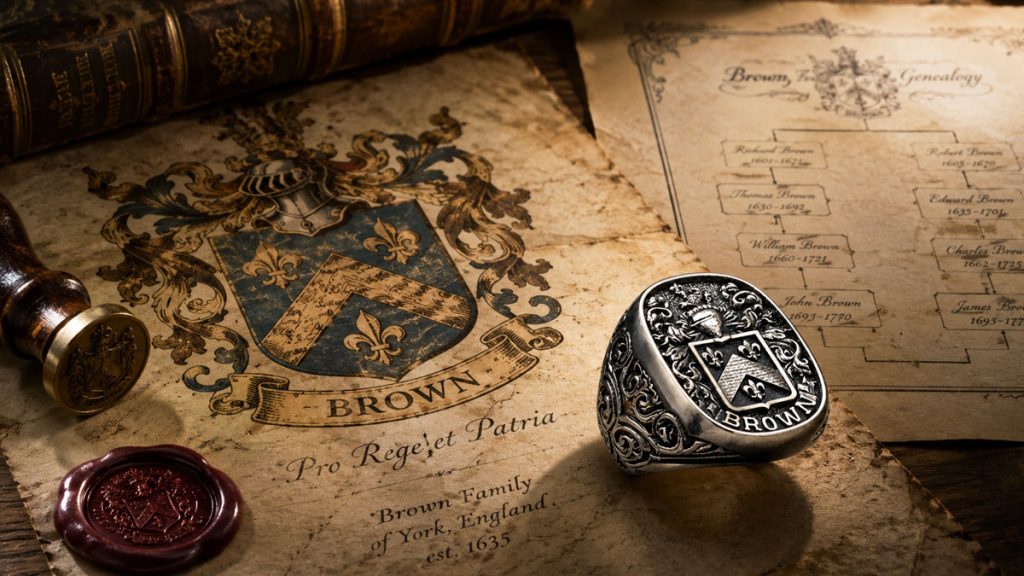
- Wax seals
- Silverware engravings
- Family portraits
- Antique documents
- Heraldic carvings
Sometimes a small heraldic symbol found on an heirloom can provide the breakthrough needed to connect a family line to official records.
Step 5: Verify Before You Buy
Many buyers discover a coat of arms online and immediately order jewelry.
However, verification should come first.
Common warning signs include:
- Instant surname searches
- Claims that every surname has one coat of arms
- No supporting genealogy
- No historical references
- Generic artwork sold to thousands of customers
Legitimate heraldic research takes time because it requires historical documentation.
As a result, reputable researchers focus on lineage rather than simply matching a surname.
Family Crest vs Coat of Arms
These terms are frequently used interchangeably, yet they are technically different.
| Term | Definition |
|---|---|
| Coat of Arms | Complete heraldic achievement |
| Crest | Symbol displayed above the helmet |
| Heraldry | The system governing coats of arms |
| Armiger | Person granted the arms |
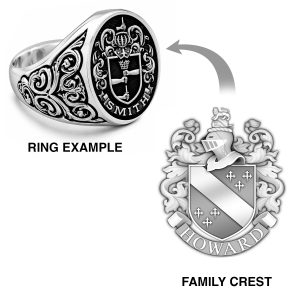
| Signet Ring | Ring engraved with heraldic symbols |
Understanding the difference helps buyers make informed decisions when ordering family crest jewelry.
What If Your Family Never Had a Coat of Arms?
Many families discover no historical coat of arms exists.
This outcome is completely normal.
Historically, only a small percentage of people possessed officially recorded arms.
Fortunately, that does not prevent you from creating a meaningful family symbol.
Many modern families choose to design their own:
- Family crest
- Coat of arms
- Clan emblem
- Heritage seal
A custom design can represent values, occupations, achievements, military service, cultural heritage, or family traditions.
For many people, creating a new family legacy is just as meaningful as discovering an old one.
Why People Turn Their Coat of Arms Into Jewelry
After discovering or designing a coat of arms, many families want a lasting way to preserve it.
Family crest jewelry transforms genealogical research into a wearable heirloom.
Popular options include:
- Family crest rings
- Signet rings
- Heraldic pendants
- Coat of arms necklaces
- Commemorative gifts
Unlike paper records, jewelry can be passed from generation to generation.
Consequently, it becomes both a historical symbol and a family keepsake.
Family Crest Rings From Dunham Jewelry
Once your coat of arms research is complete, a custom family crest ring provides a lasting way to celebrate your heritage.
Dunham Jewelry Manufacturing, Inc. manufactures family crest rings directly rather than operating as a retail reseller. Each ring is handcrafted individually and can be customized with family crests, coats of arms, mottos, initials, dates, and personal engravings.
The company offers multiple metal options including Palisil, Sterling Silver, Questra, and traditional gold while backing its products with a Lifetime Warranty.
Additionally, Dunham Jewelry can assist with coat of arms research and provide findings within approximately three business days based on the information supplied by the customer.
Dunham Jewelry Manufacturing, Inc.
822 Southwestern Dr.
El Paso, TX 79912
(915) 845-1722
Common Mistakes People Make
Many researchers unknowingly make the same errors.
Avoid these common pitfalls:
- Assuming every surname has a coat of arms
- Purchasing jewelry before verification
- Ignoring genealogy records
- Relying solely on online surname databases
- Confusing a crest with a full coat of arms
- Overlooking ancestral location differences
Avoiding these mistakes can significantly improve research accuracy.
Is Finding Your Family Coat of Arms Worth It?
For many people, absolutely.
The value extends beyond discovering a symbol.
You gain:
- Better understanding of family history
- Stronger connection to ancestors
- Preservation of heritage
- Meaningful heirloom opportunities
- Personalized family legacy
Whether you uncover a centuries-old heraldic design or create a new family emblem, the process often becomes an important part of preserving family identity.
Final Thoughts
Finding your family coat of arms is a process of historical research rather than a simple surname lookup. The most reliable path involves tracing your ancestry, identifying ancestral locations, consulting official heraldic records, and verifying legitimate family connections.
Although many people hope to discover an ancient coat of arms, creating a new family symbol can be equally meaningful. Ultimately, the goal is not simply to find a design—it is to preserve and celebrate your family’s story for future generations.
FAQs
Does every surname have a coat of arms?
No. Coats of arms belong to individuals and their descendants, not entire surnames.
How do I know if a coat of arms is authentic?
Verify it through genealogical research and official heraldic records rather than surname databases.
What is the difference between a crest and a coat of arms?
A crest is only one element of a complete coat of arms and usually appears above the helmet.
Can Americans have a coat of arms?
Yes. In the United States, individuals may legally assume and use their own coat of arms.
Can I create my own family crest?
Yes. Many families design their own heraldic symbols when no historical coat of arms exists.
How long does coat of arms research take?
Research timelines vary, although basic investigations may take days while extensive genealogy projects can take months.
What is a family crest ring?
A family crest ring is a custom signet-style ring engraved with a family crest, coat of arms, or heraldic symbol.
Can Dunham Jewelry research my coat of arms?
Yes. Dunham Jewelry offers coat of arms research assistance and can provide findings based on customer information.