
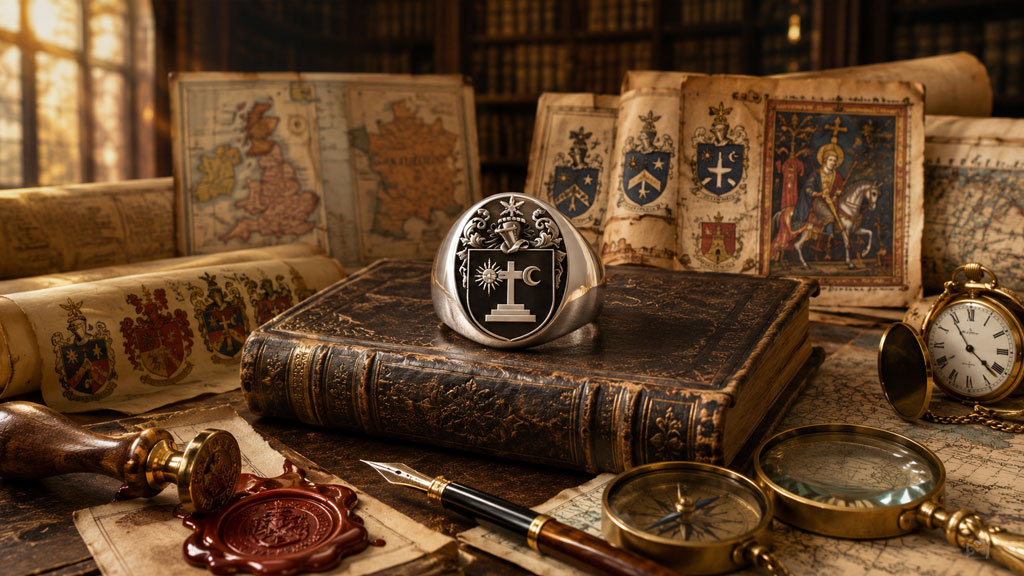
Martin Family Crest Signet Rings
Martin family crest signet rings are custom heirloom pieces engraved with one of the historical coats of arms associated with the Martin surname. Because Martin families developed across England, Ireland, Scotland, France, and other regions, there is no single universal Martin family crest. The appropriate heraldic design depends on your documented ancestry.
A well-made Martin family crest ring combines genealogy, traditional symbolism, and custom jewelry craftsmanship. Therefore, choosing the right design involves more than selecting the most attractive shield. Buyers should also consider lineage, engraving style, face shape, metal, durability, and the quality of the manufacturer.
| Feature | Why It Matters |
|---|---|
| Multiple Martin coats of arms | Different Martin families may have different heraldic designs based on ancestry and geographic origin. |
| Custom engraving | The ring can be personalized using a documented family crest, coat of arms, monogram, or custom symbol. |
| Handcrafted manufacturing | Individual production supports sharper engraving, cleaner finishing, and better structural integrity. |
| Metal selection | Buyers can choose a metal based on appearance, budget, durability, resizing needs, and long-term value. |
| Heirloom potential | A quality signet ring can become a meaningful family keepsake passed to future generations. |
What Is a Martin Family Crest Signet Ring?
A Martin family crest signet ring is a personalized piece of heraldic jewelry featuring a coat of arms or crest associated with a specific Martin family lineage. Although the terms family crest and coat of arms are often used interchangeably, they are not technically identical.
A coat of arms usually refers to the complete heraldic composition, which may include a shield, helmet, mantling, motto, supporters, and crest. The crest is traditionally the element positioned above the helmet. However, modern buyers commonly use “family crest ring” to describe a signet ring engraved with any recognizable portion of the family’s heraldic design.
Unlike generic surname jewelry, a custom Martin heraldic ring should not assume that everyone named Martin shares the same arms. Instead, the design should reflect a documented ancestral branch or be presented as a custom heraldic interpretation.
Why Different Martin Families Have Different Coats of Arms
Historically, coats of arms were granted to specific individuals and inherited through particular family lines. They were not automatically assigned to everyone sharing the same surname. Consequently, two unrelated families named Martin could possess entirely different heraldic designs.
The Martin surname developed in several countries and regions, including England, Ireland, Scotland, France, and parts of continental Europe. Migration, marriage, military service, land ownership, and separate heraldic grants created numerous legitimate variations. Therefore, surname alone is not enough to establish ownership of a particular coat of arms.
Expert Insight: Heraldry identifies a specific ancestral line rather than an entire surname. Researching your family history before choosing a Martin coat of arms helps preserve historical accuracy and gives the finished ring greater personal meaning.
The History of the Martin Surname and Heraldic Tradition
The Martin surname is generally connected to the Latin personal name Martinus, which was derived from Mars, the Roman god traditionally associated with strength and warfare. The name also became widespread through the influence of Saint Martin of Tours, one of medieval Europe’s most recognized Christian saints.
As the name spread, separate Martin families emerged in different regions. English, Irish, Scottish, French, and Norman branches developed their own histories and, in some cases, their own coats of arms. As a result, Martin heraldry reflects a broad range of symbols, colors, shields, crests, and mottos.
This varied history is one reason Martin family crest jewelry should be approached carefully. A ring becomes more meaningful when its design is tied to a known family line rather than selected solely from a surname chart.
Common Martin Coat of Arms Variations
Several heraldic motifs have been associated with different Martin families. However, these examples should not be treated as a single universal crest for everyone bearing the surname.
One widely recognized variation features a Calvary cross standing on three steps, sometimes accompanied by a sun in splendor and a crescent moon. Depending on the family branch, these elements may represent faith, guidance, endurance, or spiritual devotion.
Other Martin arms feature a rampant lion. In heraldry, lions commonly symbolize courage, authority, leadership, and determination. However, the lion’s color, position, surrounding symbols, and shield design may differ significantly between lineages.
Some Martin shields also use alternating horizontal bars of red and silver, known in heraldic terminology as gules and argent. Although this design appears simpler, additional elements such as crests, mantling, helmets, or mottoes may distinguish one Martin family from another.
How to Verify Your Martin Family Lineage
Choosing the right Martin family crest should begin with genealogy rather than appearance. First, identify the countries, counties, towns, or parishes connected to your ancestors. Even a general geographic origin can help narrow the range of possible heraldic designs.
Next, examine family records such as birth certificates, marriage records, census documents, immigration files, church registers, military records, wills, land records, and old family Bibles. Additionally, historic wax seals, engraved silver, framed coats of arms, or handwritten family trees may provide useful clues.
Genealogy databases, national archives, libraries, historical societies, and professional genealogists can also support your research. However, buyers should remain cautious when a website claims that one coat of arms automatically belongs to everyone with the Martin surname.
- Confirm the earliest documented Martin ancestor in your family tree.
- Identify the geographic region connected to that ancestor.
- Compare the lineage with reliable heraldic records.
- Preserve copies of the documents supporting your selection.
- Ask the manufacturer whether custom artwork can be supplied.
How to Choose the Right Martin Family Crest
The best design is the one most closely connected to your documented family history. Therefore, avoid choosing a crest only because it looks impressive. A historically grounded design will carry more significance than a generic image associated with the surname.
If your family already has a coat of arms recorded in documents, photographs, wax seals, or inherited objects, provide those references to the manufacturer. Clear artwork helps preserve small details such as shield divisions, animals, crosses, stars, crescents, mantling, and mottoes.
When no verified crest is available, a custom interpretation may be more appropriate. For example, a family may choose a monogram, initials, meaningful symbols, or a newly designed heraldic composition. However, it should be described honestly as a custom family design rather than an ancient inherited coat of arms.
Raised, New Traditional, or Old Traditional Engraving
After selecting the artwork, buyers must decide how the design will appear on the ring. Each engraving style creates a different visual effect and serves a different purpose.
| Engraving Style | Appearance | Best For |
|---|---|---|
| Raised Traditional | The design projects above the ring surface with sculptural depth. | Buyers seeking bold detail and a traditional heirloom appearance. |
| New Traditional | The design is engraved in the correct viewing orientation. | Everyday wear and buyers who want crisp recessed detail. |
| Old Traditional | The design is engraved in reverse. | Collectors and buyers who want to create correctly oriented wax seals. |
Raised Traditional engraving emphasizes depth and dimension. Lions, shields, crosses, mantling, and other heraldic elements appear more sculptural, making this style especially attractive for display and heirloom presentation.
New Traditional engraving places the image in the correct orientation when viewed directly on the ring. However, if pressed into wax, the seal impression will appear reversed.
Old Traditional engraving reverses the image on the ring so that a wax impression appears correctly oriented. This style preserves the functional tradition of historic signet rings.
Oval vs. Antique Face Styles
The face shape affects the overall personality of the ring without changing the underlying heraldic design. The Oval Collection offers a smooth, symmetrical profile associated with classic signet jewelry. Because of its rounded shape, it complements a wide variety of shields and crest compositions.
In contrast, the Antique Collection has a more rectangular face with softened corners. This style often appears bolder and more architectural. It also creates a distinctive frame around the engraving, making it appealing to buyers who prefer a substantial vintage-inspired ring.
| Face Style | Visual Character | Best Fit |
|---|---|---|
| Oval | Traditional, smooth, and balanced | Classic styling, formal wear, and understated daily use |
| Antique | Bold, structured, and vintage-inspired | Buyers seeking a larger visual presence and distinctive profile |
Neither style is inherently more authentic. Ultimately, the better option is the one that fits the wearer’s personal taste, hand size, and preferred level of visual prominence.
Choosing the Best Metal for a Martin Family Crest Ring
The metal affects the ring’s color, weight, price, durability, maintenance requirements, and long-term value. Therefore, buyers should consider how often the ring will be worn and whether future resizing may be important.
| Metal | Primary Advantages | Best For |
|---|---|---|
| Palisil | Durable, affordable, and similar in appearance to white precious metal | Value-focused buyers and regular wear |
| Yellow Palisil | Gold-colored appearance at a lower initial cost | Occasional wear and budget-conscious gifting |
| Black Palisil | Modern gunmetal-style finish | Contemporary and bold styling |
| Sterling Silver | Bright precious-metal finish and traditional appeal | Classic heraldic jewelry at a moderate price |
| Questra 6K Gold | Genuine gold content with resizing capability | Buyers seeking an accessible gold option |
| 10K Gold | High durability and genuine gold value | Frequent wear and active lifestyles |
| 14K Gold | Balanced durability, color, and gold content | Premium everyday wear and heirloom gifting |
| 18K Gold | Rich color and higher gold purity | Luxury heirlooms and formal jewelry |
Palisil is a practical choice for buyers who want durability and an accessible price. Yellow Palisil offers a gold-toned appearance, although plated finishes are generally better suited to occasional wear. Black Palisil provides a modern alternative for buyers who prefer a darker finish.
Sterling Silver offers the brightness and prestige of a traditional precious metal. However, it may develop tarnish over time and requires periodic care. Questra provides genuine gold content at a lower price than traditional gold alloys and may also offer resizing flexibility.
For frequent wear, 10K gold offers notable durability. Meanwhile, 14K gold provides a popular balance of color, strength, and long-term value. Finally, 18K gold offers richer color and higher purity, although its greater gold content may make it softer and more expensive.
Why Handcrafted Manufacturing Matters
Two rings can feature similar artwork yet differ substantially in engraving quality, weight, finishing, and durability. The manufacturing process often explains the difference.
Mass-produced jewelry is typically designed for speed and volume. Consequently, it may use lighter construction, simplified engraving, or limited customization. Individually manufactured rings allow more attention to detail throughout the design, casting, engraving, polishing, and inspection stages.
Hand finishing can improve edge definition, engraving clarity, surface polish, and overall presentation. Additionally, direct manufacturing allows the company producing the ring to maintain control over materials and quality instead of depending on an unknown third-party supplier.
Dunham Jewelry Manufacturing, Inc. manufactures and finishes rings individually in the United States. Customers purchase directly from the manufacturer rather than through a traditional retail middleman. This approach supports greater customization, transparent material choices, and direct accountability for the completed piece.
Direct Manufacturer vs. Jewelry Reseller
| Consideration | Direct Manufacturer | Typical Reseller |
|---|---|---|
| Production control | Controls design, manufacturing, finishing, and inspection | May rely on outside suppliers |
| Customization | Can often modify artwork, metals, engraving, and ring details | May be limited to preset catalog options |
| Pricing structure | Reduces unnecessary retail markups | May include distributor and retailer margins |
| Material transparency | Can explain alloys and manufacturing directly | May have limited production information |
| Warranty support | Handled by the company that made the ring | May require communication with another supplier |
Buying directly from the manufacturer does not automatically guarantee superior quality. However, it does make it easier to ask detailed questions about materials, construction, engraving, customization, resizing, and warranty coverage.
Is a Martin Family Crest Ring Worth It?
A Martin family crest ring can be worth the investment when the buyer values ancestry, custom design, craftsmanship, and long-term ownership. Unlike trend-driven fashion jewelry, a heraldic ring carries personal meaning that may grow stronger over time.
The ring may commemorate a graduation, wedding, anniversary, retirement, family reunion, or genealogical discovery. Furthermore, it can become a physical record of family identity and a keepsake that later generations continue to wear.
Value should not be measured only by the initial price. The correct design, material quality, engraving detail, manufacturer support, resizing options, warranty, and emotional significance all contribute to the ownership experience.
Who Is a Martin Family Crest Ring Best For?
- Genealogy and family history enthusiasts
- Individuals celebrating Martin ancestry
- Parents or grandparents creating a family heirloom
- Graduation, retirement, or milestone gift buyers
- Collectors of heraldic and signet jewelry
- Buyers seeking personalized formal jewelry
- Families commemorating reunions or ancestry research
A custom ring is especially appropriate for someone who appreciates the meaning behind the design. In contrast, a buyer seeking inexpensive trend jewelry may find a highly customized heraldic ring more detailed than necessary.
When a Family Crest Ring May Not Be Ideal
A heraldic ring may not be the best choice for someone who has no interest in genealogy or who wants a disposable fashion accessory. It may also be unsuitable for buyers unwilling to research their lineage but expecting guaranteed historical accuracy.
Additionally, certain metals and detailed finishes may require more maintenance than simple contemporary jewelry. Buyers who work regularly with machinery, heavy tools, chemicals, or abrasive materials may need to remove the ring during those activities.
In such cases, a simpler monogram ring, pendant, or custom symbol may be a better fit. These alternatives still provide personalization without making unsupported claims about ancestral heraldry.
Common Buying Mistakes to Avoid
Assuming one crest belongs to every Martin. The Martin surname includes numerous unrelated family lines. Therefore, buyers should verify ancestry before claiming a specific coat of arms.
Choosing appearance over historical relevance. A dramatic lion or elaborate shield may look impressive, but it may not relate to the buyer’s family branch.
Ignoring engraving orientation. Buyers who want to make wax seals should select Old Traditional reverse engraving rather than a design intended only for direct viewing.
Selecting metal based only on price. Durability, maintenance, resizing, finish longevity, and intended wear should also influence the decision.
Buying from a seller with limited manufacturing information. Ask where the ring is made, what metal is used, whether the design is custom, and what the warranty covers.
Martin Family Crest Ring Buying Checklist
- Verify the Martin lineage or geographic family branch.
- Select a documented coat of arms or clearly labeled custom design.
- Choose Raised, New Traditional, or Old Traditional engraving.
- Decide between an Oval or Antique ring face.
- Compare metals based on durability, budget, care, and resizing.
- Confirm the ring size before production.
- Review the supplied crest artwork carefully.
- Ask where and how the ring will be manufactured.
- Confirm warranty and service terms.
- Add a personal interior engraving when appropriate.
Create Your Custom Martin Family Crest Signet Ring
A Martin family crest signet ring represents more than decorative jewelry. It can preserve ancestry, commemorate a milestone, and create a physical connection between generations. However, the strongest designs begin with accurate information and realistic expectations.
First, verify the family lineage whenever possible. Next, select the appropriate heraldic artwork or create a clearly identified custom design. Then compare engraving styles, face shapes, metals, sizing, and personalization options.
Dunham Jewelry Manufacturing, Inc. produces custom rings individually in the United States. Buyers purchase directly from the manufacturer and can choose from multiple ring designs, engraving methods, and metal options. Each custom piece is manufactured and finished by hand and backed by a Lifetime Warranty.
By combining family research with skilled American manufacturing, a custom Martin family crest ring can honor the past while becoming a meaningful part of the family’s future.
Frequently Asked Questions About Martin Family Crest Signet Rings
Does every Martin family have the same coat of arms?
No. Different Martin families developed in separate geographic regions and may have different coats of arms. A surname alone does not prove entitlement to one particular heraldic design.
How do I know which Martin crest belongs to my family?
Begin with genealogy records, including birth certificates, census records, church registers, immigration files, wills, military documents, and family archives. Then compare your ancestral branch with reliable heraldic sources.
Can I use a custom design instead of a historical coat of arms?
Yes. A manufacturer can often engrave a custom shield, monogram, initials, motto, or meaningful family symbols. However, a newly created design should not be presented as an inherited historical coat of arms.
Which engraving style is best for everyday wear?
New Traditional recessed engraving is a practical choice for everyday wear. Raised Traditional provides more sculptural detail, while Old Traditional is best when the ring will be used to make wax seals.
Which engraving style makes a correct wax seal?
Old Traditional engraving is cut in reverse. Therefore, when the ring is pressed into sealing wax, the impression appears in the correct orientation.
What is the difference between Oval and Antique signet rings?
Oval rings have a fully rounded face with a classic signet profile. Antique rings are more rectangular with rounded corners and generally create a bolder, vintage-inspired appearance.
What is the best metal for a family crest ring?
The best metal depends on budget, wear habits, color preference, and long-term goals. Palisil offers affordability, Sterling Silver provides classic precious-metal appeal, and 10K or 14K gold are strong choices for frequent wear and heirloom value.
Can a Martin family crest ring be resized?
Resizing depends on the selected metal, ring design, size difference, and construction. Buyers should ask about resizing before ordering, especially when planning to pass the ring to another generation.
Can I add an interior engraving?
Yes. Interior engravings may include names, initials, dates, mottoes, memorial messages, or references to a particular family branch.
Can a family crest ring become an heirloom?
Yes. A well-made ring featuring a meaningful and carefully selected design can be passed through generations as a symbol of ancestry, achievement, and family identity.