Moore Family Crest Signet Rings
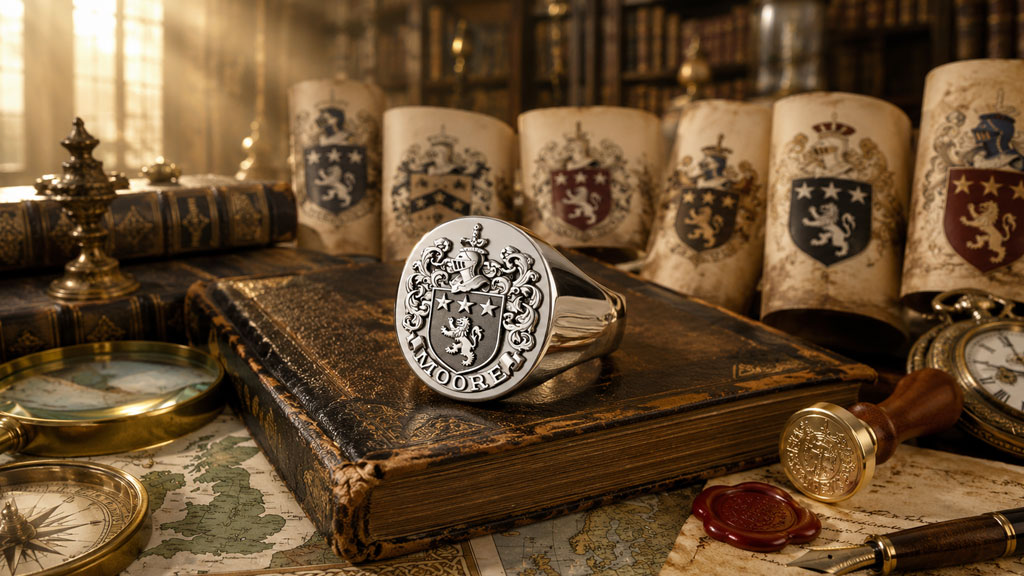
Moore Family Crest signet rings are personalized heraldic jewelry designed to showcase a family’s unique coat of arms or crest. Because multiple Moore family lineages exist across Ireland, England, and Scotland, there is no single universal Moore crest. A custom ring should reflect your specific ancestral heritage while offering durable craftsmanship and personalized design options.
Moore Family Crest signet rings are custom heraldic rings displaying a coat of arms, crest, initials, or another family design. Because Moore families developed across Ireland, England, Scotland, and other regions, no single crest represents everyone with the surname. The most meaningful ring uses documented family artwork or a clearly identified custom interpretation.
A custom Moore signet ring can honor ancestry, commemorate a milestone, or become a family heirloom. However, buyers should compare more than appearance. Engraving style, metal, artwork quality, manufacturing, sizing, and warranty coverage all affect the finished ring’s value.
Moore Family Crest Signet Rings at a Glance
| Decision | Main Options | Best Fit |
|---|---|---|
| Heraldic design | Documented arms, supplied artwork, or custom interpretation | Buyers seeking meaningful family symbolism |
| Engraving | Raised, New Traditional, or Old Traditional | Visual depth, everyday presentation, or wax-seal use |
| Face shape | Oval or Antique | Classic or more structured signet styling |
| Metal | Palisil, Sterling Silver, Questra, 10K, 14K, or 18K Gold | Different budgets, lifestyles, and heirloom goals |
| Personalization | Initials, dates, mottos, symbols, and side designs | Creating a one-of-a-kind family keepsake |
Is There One Official Moore Family Crest?
Short answer: there is no single Moore coat of arms that represents every person with the surname. Historically, coats of arms were associated with particular individuals or family lines rather than automatically belonging to everyone who shared a last name.
As a result, unrelated Moore families may have different shields, colors, crests, mottos, and regional traditions. One family may trace its history through Ireland, while another may have English or Scottish records. Therefore, a surname match alone does not prove that a particular coat of arms belongs to your direct ancestors.
Buyers can begin with genealogy documents, inherited artwork, seals, photographs, military records, cemetery records, or earlier family research. When documented artwork is unavailable, a custom heraldic interpretation can still be created. However, it should be described honestly as a personalized design rather than the universal Moore family crest.
How to Choose the Right Moore Crest Design
First, decide whether your priority is documented ancestry, visual symbolism, or both. A genealogy-focused buyer may want to reproduce inherited artwork accurately. In contrast, a gift buyer may prefer a dignified design that represents family pride without making a strict historical claim.
Next, gather the clearest references available. High-resolution scans, photographs, sketches, seals, and printed records can help a jewelry designer understand the intended symbols. Additionally, identify any detail that must remain unchanged, such as a motto, animal, crown, cross, star, shield division, or family initial.
Complex heraldic artwork may need careful simplification because a ring face has limited space. Strong outlines, balanced spacing, and readable symbols usually produce a better result than overcrowded micro-detail.
Raised, New, and Old Traditional Engraving Compared
| Style | Appearance | Best For |
|---|---|---|
| Raised Traditional | The design rises above the surrounding surface | Maximum depth and a sculpted presentation |
| New Traditional | The design is engraved below the surface in the correct viewing direction | Clear presentation and practical everyday wear |
| Old Traditional | The design is reverse engraved | Creating correctly oriented wax-seal impressions |
Best for visual depth: Raised Traditional emphasizes shields, animals, initials, and central symbols with a sculpted appearance.
Best for everyday presentation: New Traditional engraving keeps the artwork readable on the ring while placing much of the detail below the surface.
Best for wax seals: Old Traditional engraving reverses the design so the impression appears correctly when pressed into wax.
Oval Versus Antique Signet Ring Styles
The Oval style has a fully rounded face and offers the classic proportions associated with traditional signet rings. It works especially well with vertical shields, initials, and compact heraldic compositions.
The Antique style is more rectangular with softened corners. Its broader, structured appearance can create a strong frame around a shield, crest, or motto.
Neither shape is inherently more authentic. Instead, the right choice depends on personal style and how the artwork fits the available space.
Choosing the Right Metal
| Metal | Main Advantage | Consideration |
|---|---|---|
| Palisil | Affordable white-metal appearance | Non-precious alloy |
| Yellow Palisil | Gold-tone appearance at a lower price | Plated finish requires appropriate care |
| Black Palisil | Bold gun-metal appearance | Modern rather than traditional styling |
| Questra | Affordable 6K gold option with resizing potential | Lower gold content than traditional gold alloys |
| Sterling Silver | Bright, classic precious metal | May tarnish and require cleaning |
| 10K Gold | Durable and comparatively affordable solid gold | Lighter gold color than higher karats |
| 14K Gold | Balanced color, durability, and value | Higher investment than silver or alternative alloys |
| 18K Gold | Rich color and higher gold content | Softer and typically more expensive |
General guidance: Sterling Silver may suit buyers seeking an affordable precious metal, while 10K or 14K Gold may appeal to those prioritizing long-term wear. Meanwhile, 18K Gold offers richer color and higher precious-metal content. The right choice still depends on budget, maintenance expectations, resizing needs, and lifestyle.
Ready to begin your design? Choose a ring shape, engraving method, and metal, then provide your Moore family artwork or request help adapting a heraldic design for the ring.
Customizing Your Moore Family Crest Ring
Customization can extend beyond the main crest. Depending on the selected ring, buyers may add initials, dates, family mottos, memorial details, religious symbols, military insignia, or meaningful side designs.
Before approving the artwork, verify all spelling, dates, symbol direction, motto wording, and shield divisions. Small errors can become highly visible after engraving. Therefore, compare the final proof with the clearest family records available.
Signet rings can also fit differently from narrow bands because of their broader faces and heavier shoulders. Accurate sizing before production can reduce the need for later adjustments.
Why Manufacturing Quality Matters
A custom heraldic ring is often purchased as a long-term keepsake, so manufacturing transparency matters. Buyers should know whether the seller produces the ring or sends the order to an outside supplier.
Dunham Jewelry Manufacturing, Inc. produces and hand-finishes custom rings in the United States. Customers purchase directly from the manufacturer and can choose from multiple engraving styles, face shapes, and metal options. The company also backs its custom rings with a Lifetime Warranty.
When evaluating any custom ring provider, look for clear metal descriptions, a design-proof process, transparent manufacturing information, established custom-jewelry experience, and written warranty terms.
Common Buying Mistakes to Avoid
- Assuming the first Moore crest found online belongs to every Moore family.
- Choosing a metal based only on the initial price.
- Submitting unclear artwork without identifying essential details.
- Skipping the design-proof review.
- Guessing the ring size.
- Ordering too close to a graduation, anniversary, reunion, or birthday.
- Ignoring the difference between decorative heraldry and documented ancestry.
Who Is a Moore Family Crest Ring Best For?
Moore Family Crest signet rings are especially well suited to genealogy enthusiasts, family historians, collectors, heritage organizations, and gift buyers who want jewelry with personal meaning.
They can commemorate graduations, weddings, anniversaries, retirements, military promotions, reunions, and milestone birthdays. Additionally, a custom ring can connect a present-day achievement to a broader family story.
A custom crest ring may not be ideal for someone who wants an immediate off-the-shelf purchase or who has no interest in personalized symbolism. In that case, a monogram signet ring may be a simpler alternative.
Are Moore Family Crest Signet Rings Worth It?
Short answer: a Moore Family Crest signet ring can be worth the investment when the design is meaningful, the material is clearly identified, and the ring is made for long-term wear.
Its value includes more than metal weight. Custom design, engraving, hand finishing, family symbolism, and future heirloom significance all contribute to the finished piece. However, buyers are less likely to be satisfied when the crest is selected carelessly or the construction is unclear.
Ultimately, a custom crest ring is best viewed as a commemorative or heirloom purchase rather than a temporary fashion accessory.
Moore Family Crest Ring Buying Checklist
- Confirm whether the design is documented, inherited, or custom interpreted.
- Gather clear reference artwork.
- Verify names, dates, symbols, and motto wording.
- Choose Raised, New, or Old Traditional engraving.
- Select an Oval or Antique ring shape.
- Compare metals by durability, maintenance, price, and resizing needs.
- Confirm the correct ring size.
- Review the final proof carefully.
- Ask where and how the ring is manufactured.
- Review warranty and service information.
- Allow sufficient time for custom production.
Create Your Custom Moore Family Crest Signet Ring
Start by selecting an Oval or Antique ring, choosing Raised, New, or Old Traditional engraving, and comparing the available metal options. You may provide documented family artwork, an inherited design, or a custom heraldic reference for adaptation.
Contact Dunham Jewelry Manufacturing, Inc. at 1-915-845-1722 for assistance with artwork, customization, sizing, or ordering.
Dunham Jewelry Manufacturing, Inc.
822 Southwestern Drive
El Paso, Texas 79912
Frequently Asked Questions
Is there one official Moore family crest?
No. Different Moore lineages may have different heraldic designs. A shared surname alone does not prove a direct connection to one specific coat of arms.
Can I use a Moore crest found online?
Yes, as inspiration or decorative heritage artwork. However, it should not automatically be described as the documented arms of your specific family branch without supporting research.
Can I submit my own family artwork?
Yes. Clear scans, photographs, drawings, seals, and genealogy documents can help the design team adapt the artwork for engraving.
Which engraving style works for wax seals?
Old Traditional engraving is reverse cut so the wax impression appears in the correct orientation.
What is the difference between Oval and Antique rings?
Oval rings have a fully rounded face. Antique rings are more rectangular with softened corners and a more structured appearance.
Which metal is best for an heirloom?
Solid gold is often preferred for long-term heirloom use. However, Sterling Silver offers a lower-cost precious-metal alternative, and the best choice depends on budget and lifestyle.
Can a Moore crest ring be personalized?
Yes. Depending on the design, buyers may add initials, dates, mottos, side symbols, memorial details, or other meaningful elements.
How early should I order?
Custom production time varies by artwork complexity, proof approval, material, and manufacturing volume. Order well before any fixed gift or event date.