White Family Crest Signet Rings: Complete Buyer’s Guide to Authentic Heraldic Jewelry
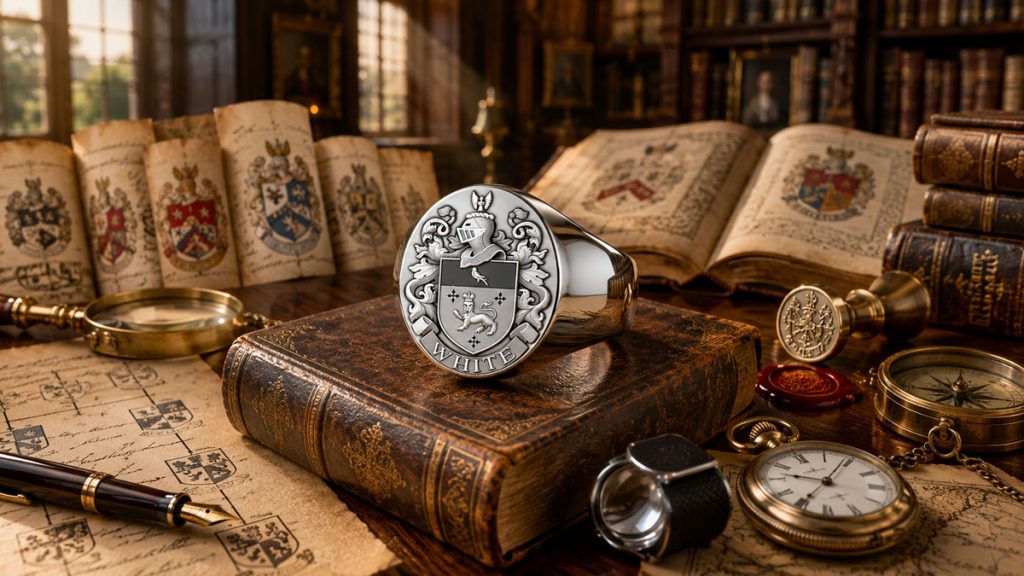
White family crest signet rings are custom heraldic rings featuring a coat of arms associated with a documented White family lineage. Because the White surname has multiple historical coats of arms, verifying ancestry before ordering is important. A custom ring can then be personalized through the crest design, metal, face shape, engraving style, inscriptions, and finish.
For many buyers, the goal is not simply to own a decorative ring. Instead, the ring represents family history, personal identity, and a legacy that can be passed to future generations.
White Family Crest Ring Quick Comparison
| Feature | Best Choice |
|---|---|
| Historical accuracy | Verify your documented White family lineage |
| Maximum visual depth | Raised engraving |
| Modern appearance | New engraving |
| Traditional wax seal use | Old reverse engraving |
| Classic ring shape | Oval |
| Vintage-inspired shape | Antique |
| Affordable white-metal appearance | Palisil |
| Traditional precious metal | Sterling silver |
| Balanced heirloom option | 14K gold |
What Is a White Family Crest Signet Ring?
A White family crest signet ring is a personalized piece of heraldic jewelry displaying armorial bearings connected to a specific White family branch. Historically, signet rings were pressed into sealing wax to authenticate letters and official documents. The engraved image identified the person or family represented by the seal.
Today, these rings are commonly worn as heirloom jewelry. They are frequently selected for graduations, anniversaries, retirements, birthdays, military milestones, memorial gifts, and family-history celebrations.
Why this matters: Unlike generic jewelry, a custom family crest ring can preserve a documented symbol, meaningful inscription, family motto, or important date in a form designed for long-term wear.
Does Every White Family Have the Same Coat of Arms?
No. The White surname has multiple historically recorded coats of arms because different White families developed in different regions and lineages. A coat of arms was traditionally granted to or used by a particular person and inherited under specific heraldic customs. It did not automatically belong to everyone sharing the surname.
Therefore, two people named White may have entirely different ancestral backgrounds. One branch may trace its history to England, while another may have Irish, Scottish, or other European origins.
Before selecting a design, consider researching:
- Your documented family tree
- Your earliest known White ancestors
- Countries, counties, or regions of origin
- Historical records, wills, seals, or family documents
- Heraldic references connected to the correct lineage
If you already possess verified family artwork, it may be used as the basis for a custom heraldic ring rather than relying on a generic surname design.
Raised, New, and Old Engraving Compared
Raised engraving places the design above the background. This creates strong depth, visible relief, and dramatic light reflection across shields, griffins, roses, mantling, and other heraldic elements. It is often the best option for buyers who want the crest to be the visual centerpiece.
New engraving cuts the design into the ring face in its normal viewing orientation. It provides crisp definition and a clean, contemporary appearance. However, when pressed into wax, the resulting seal appears reversed.
Old engraving uses a reversed image on the ring. Consequently, the wax impression appears in the correct orientation. This is the traditional choice for collectors, genealogy enthusiasts, and buyers who want to use the ring as a functional heraldic seal.
Oval vs. Antique Face Shapes
The Oval collection has a smooth, fully oval face associated with classic signet-ring styling. It works well for first-time buyers and provides a balanced frame for detailed heraldic artwork.
In contrast, the Antique collection is more rectangular with rounded corners. Its profile creates a stronger vintage character and may appeal to buyers who prefer the look of historic European jewelry.
Neither shape is inherently more authentic. Instead, the best choice depends on personal style, crest proportions, finger size, and the amount of detail in the artwork.
Choosing the Best Metal
| Metal | Best For |
|---|---|
| Palisil | Durable, affordable white-gold appearance |
| Yellow Palisil | Gold-tone appearance for occasional wear |
| Black Palisil | Bold gunmetal styling |
| Questra | Affordable 6K gold option with resizing capability |
| Sterling Silver | Classic precious metal at an accessible price |
| 10K Gold | Strong daily-wear durability |
| 14K Gold | Balance of strength, beauty, and heirloom value |
| 18K Gold | Premium gold content and rich color |
For regular wear, durability and maintenance should matter as much as appearance. Sterling silver is an attractive traditional option, although it may require periodic polishing. Meanwhile, 10K gold offers additional hardness, and 14K gold is often selected for its balance of durability and precious-metal value.
Yellow and Black Palisil can provide distinctive styling at a lower price. However, buyers should consider how often the ring will be worn and whether long-term precious-metal value is a priority.
How a Handcrafted Family Crest Ring Is Made
The process begins with the selected heraldic artwork. The design is prepared for the chosen ring shape and engraving method, then the ring is manufactured in the selected metal. Afterward, craftsmen refine the engraving, finish the surface, polish the ring, and inspect the completed piece.
At Dunham Jewelry Manufacturing, Inc., rings are manufactured and finished individually in the United States rather than purchased as completed products from outside suppliers. The company states that it combines more than 100 years of custom jewelry manufacturing experience and backs its rings with a lifetime warranty.
Why this matters: Individual manufacturing allows closer control over engraving detail, finishing quality, structural integrity, material information, and customization.
Custom Handcrafted Rings vs. Generic Imported Rings
| Feature | Custom Handcrafted Ring | Generic Imported Ring |
|---|---|---|
| Lineage-specific artwork | Available | Often limited |
| Personal engraving | Extensive options | Usually basic |
| Metal selection | Multiple alloys and precious metals | Often limited |
| Manufacturing transparency | Direct communication possible | May be unclear |
| Hand finishing | Individual attention | Often production-line finishing |
| Warranty | May include lifetime coverage | Frequently limited |
Custom rings generally cost more than basic imports because the price reflects individualized artwork, manufacturing, engraving, finishing, metal selection, and quality control. Therefore, the better comparison is not simply purchase price. Buyers should also consider longevity, repair support, customization, and sentimental value.
Who Is a White Family Crest Ring Best For?
- Genealogy and family-history enthusiasts
- Collectors of heraldic or signet jewelry
- Parents and grandparents creating heirlooms
- Graduates and professionals marking an achievement
- Anniversary, retirement, or milestone gift buyers
- People with verified coat-of-arms artwork
This type of ring may not be ideal for someone seeking inexpensive trend jewelry or a universal crest based only on a surname. In that situation, a simpler monogram signet ring may offer a more accurate and affordable alternative.
Common Buying Mistakes to Avoid
- Assuming every White family uses one coat of arms
- Selecting artwork without reviewing lineage
- Choosing metal based only on color
- Ignoring daily-wear durability
- Ordering without confirming ring size
- Overlooking engraving orientation
- Choosing a retailer without understanding who manufactures the ring
Additionally, buyers should review warranty terms, resizing limitations, expected production time, and personalization details before placing an order.
Before You Order
- Verify the family branch or artwork you want represented
- Choose Raised, New, or Old engraving
- Select an Oval or Antique face
- Compare metal durability, maintenance, and value
- Confirm the correct ring size
- Choose names, dates, initials, or motto engraving
- Review the warranty and manufacturing process
Completing these steps reduces uncertainty and helps ensure the finished ring reflects both your ancestry and your practical expectations.
Is a White Family Crest Signet Ring Worth It?
For buyers who value family heritage, customization, and lasting craftsmanship, a White family crest signet ring can be a worthwhile heirloom purchase. Its value comes from more than the metal alone. The ring can preserve documented ancestry, commemorate an achievement, and create a physical connection between generations.
Ultimately, the best ring is one that combines accurate or personally meaningful artwork with a metal, engraving style, and construction method suited to how it will be worn.
Create a White Family Crest Ring That Reflects Your Story
A meaningful family crest ring begins with careful choices. First, identify the White family branch or heraldic design you want to represent. Next, select the engraving style, face shape, metal, and personalization that suit your needs. Finally, choose a manufacturer that clearly explains its materials, production process, customization options, and warranty.
When those elements come together, the result is more than a signet ring. It becomes a personal record of heritage designed to be worn, remembered, and passed forward.