Anderson Family Crest Signet Rings
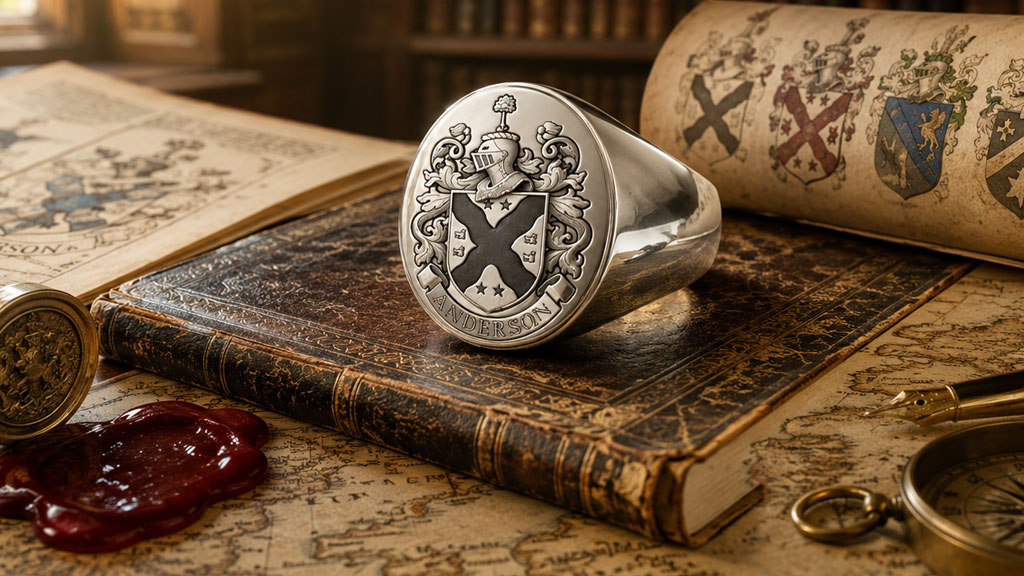
Anderson family crest signet rings can feature different heraldic designs because the Anderson surname has several historical origins and family branches. Buyers commonly choose either the well-known Scottish Anderson clan crest badge featuring an oak tree and the motto “Stand Sure”, or a documented coat of arms connected to their own ancestral lineage.
There is no single Anderson family crest because different Anderson family lines developed distinct heraldic traditions.
Understanding this distinction can help you create a ring that respectfully represents your heritage while becoming a meaningful heirloom for future generations.
Quick Answer
- No single coat of arms belongs to every Anderson family.
- The familiar Scottish Anderson clan badge commonly features an oak tree and the motto “Stand Sure.”
- Buyers may choose a clan badge, documented family arms or custom heraldic artwork.
- Raised engraving emphasizes visual depth, while reverse engraving can create readable wax seals.
Signet Ring: A signet ring is a ring with a shaped or flat face designed to display a family crest, coat of arms, monogram, emblem or engraved seal.
| If You Want… | Recommended Choice |
|---|---|
| Scottish heritage representation | Anderson clan crest badge |
| Lineage-specific heraldry | Documented coat of arms |
| Maximum visual depth | Raised Traditional |
| Functional wax seal | Old Traditional |
| Readable everyday engraving | New Traditional |
| Accessible non-precious metal | Palisil® |
| Classic precious metal | Sterling Silver |
| Premium heirloom | 10K, 14K or 18K Gold |
Is There One Anderson Family Crest?
One of the most common misconceptions is that every person with the Anderson surname shares the same family crest. In reality, there is no universal Anderson coat of arms. The surname developed through multiple Scottish, English, Irish and other family lines over many centuries, resulting in several distinct heraldic designs.
For many buyers with Scottish ancestry, the Anderson clan crest badge is the most recognizable choice. However, people who have researched their genealogy may discover arms associated with a particular ancestral branch.
A shared surname alone does not automatically prove descent from the person for whom a coat of arms was originally granted or recognized. Buyers seeking lineage-specific accuracy should use reliable genealogical or heraldic records before selecting a complete coat of arms.
Why this matters: Understanding your intended connection to the design helps ensure that your custom ring reflects the family story you want to preserve rather than relying on a generic surname image.
The Scottish Anderson Clan Crest and “Stand Sure”
Among the designs associated with the Anderson surname, the Scottish clan crest badge is one of the best known. It commonly features an oak tree surrounded by a traditional strap-and-buckle design and carries the motto “Stand Sure.”
The oak tree traditionally suggests strength, endurance, resilience and steadfast character. The motto expresses confidence, loyalty and perseverance—qualities that continue to resonate with many Anderson descendants.
Other Anderson heraldic traditions may use different shields, saltires, stars, crescents or arrangements depending on the specific family line. Customers who possess documented family records, inherited seals or historical artwork may prefer a custom reproduction of that design.
Clan Crest Badge vs. Anderson Coat of Arms
A clan crest badge and a complete coat of arms are related heraldic forms, but they are not identical.
| Clan Crest Badge | Coat of Arms |
|---|---|
| Expresses Scottish clan affiliation | Associated with a specific armiger or lineage |
| Often places a crest and motto inside a strap-and-buckle design | May include a shield, crest, helmet, mantling and motto |
| Popular for broad Scottish heritage | Best when supported by family research |
| Usually simpler to reproduce at ring scale | May require careful artwork preparation |
If your goal is to celebrate broad Scottish heritage, the Anderson clan crest badge may be an excellent choice. If your genealogy research has identified documented arms connected to your family, reproducing those elements can create a more lineage-specific heirloom.
Expert Insight: The most meaningful family crest ring is not necessarily the most elaborate. It is the design that best reflects your heritage, purpose and personal connection.
Compare Anderson Family Crest Signet Ring Engraving Styles
After selecting the artwork, the next decision is how the design should appear on the ring. Dunham Jewelry offers three traditional approaches, each created for a different visual or functional purpose.
| Style | Best For | Appearance | Important Consideration |
|---|---|---|---|
| Raised Traditional | Maximum visual depth | Artwork projects above the ring face | Designed primarily for display rather than seal impressions |
| New Traditional | Everyday display | Recessed artwork reads correctly on the ring | A wax impression would appear reversed |
| Old Traditional | Functional wax seals | Artwork is engraved in reverse | The design intentionally looks backward on the ring |
Choose Raised Traditional for sculptural depth and maximum visual impact. Choose New Traditional when the ring will primarily be worn as jewelry. Choose Old Traditional when you want the ring to produce a correctly oriented wax impression.
Oval or Antique Signet Ring?
The Oval Collection features a smooth, fully oval face associated with classic signet-ring styling. Its balanced proportions work well with clan crest badges, shields and many complete heraldic designs.
The Antique Collection has a broader profile with softly rounded corners. This creates a bold traditional appearance and can provide additional visual presence for complex artwork.
Neither shape is universally better. The right choice depends on your preferred style, finger proportions, artwork complexity and how prominent you want the ring to appear.
Which Metal Is Best for an Anderson Family Crest Signet Ring?
The metal affects the ring’s appearance, wear characteristics, maintenance, precious-metal content and long-term value. The best option depends on your budget, how frequently the ring will be worn and whether it is intended as an occasional keepsake or a generational heirloom.
| Metal | Best For | Key Characteristics |
|---|---|---|
| Palisil® | Budget-conscious buyers | Durable non-precious alloy designed to resemble white gold |
| Yellow Palisil® | Occasional wear with a gold-colored appearance | Gold-plated finish |
| Black Palisil® | Contemporary styling | Bold gun-metal appearance |
| Sterling Silver (.925) | Classic precious-metal value | Bright, versatile and traditional |
| Questra® 6K Gold | Accessible gold content | Affordable gold option with resizing capability |
| 10K Gold | Frequent wear | Durable solid-gold option |
| 14K Gold | Long-term heirloom use | Strong balance of color, durability and gold content |
| 18K Gold | Premium heirloom jewelry | Rich gold color and higher precious-metal content |
Expert Insight: Rather than asking which metal is universally best, consider how the ring will actually be used. A daily-wear heirloom and an occasional ceremonial keepsake may require different materials.
Best Anderson Family Crest Ring for Your Situation
For Scottish heritage: Consider the Anderson clan crest badge featuring the oak tree and “Stand Sure.”
For documented genealogy: Use heraldic artwork connected to a researched ancestral line.
For daily wear: Raised Traditional or New Traditional engraving in sterling silver, 10K gold or 14K gold may provide an appealing balance of visibility and durability.
For a functional wax seal: Select Old Traditional reverse engraving.
For a premium family heirloom: Consider custom family artwork, Raised Traditional engraving and solid 14K or 18K gold.
For gifts: Anderson family crest rings can commemorate graduations, weddings, anniversaries, retirements, family reunions and milestone birthdays.
Common Buyer Mistakes
- Assuming every Anderson uses the same crest: Several heraldic traditions are associated with the surname.
- Choosing artwork before researching ancestry: Decide whether you want general clan symbolism or lineage-specific arms.
- Ignoring engraving orientation: Reverse engraving is required for a correctly oriented wax seal.
- Choosing metal based only on price: Consider wear frequency, maintenance, resizing and heirloom goals.
- Ordering without confirming ring size: Custom rings should be sized carefully before manufacturing.
- Overloading a small ring face: Excessive detail can reduce engraving clarity.
- Buying from an unclear source: Verify the manufacturer, material composition, customization options and warranty.
Why Manufacturing Quality Matters
A family crest ring preserves symbols that may carry deep personal or historical meaning. The quality of the engraving, metal, structure and finishing therefore matters.
Dunham Jewelry Manufacturing, Inc. is a direct manufacturer rather than a reseller. The company maintains control over design, manufacturing, finishing, polishing and quality inspection.
Every custom ring is manufactured individually and hand-finished rather than mass-produced, allowing finer engraving definition and closer quality control throughout production.
Customers also benefit from:
- Direct-from-manufacturer pricing
- Transparent material information
- Multiple precious and non-precious metal choices
- Extensive customization
- Made-in-the-USA manufacturing
- A lifetime warranty
- More than 100 years of combined custom-jewelry manufacturing experience
How to Order an Anderson Family Crest Signet Ring
- Choose an Anderson clan crest, documented coat of arms or custom family design.
- Select Raised Traditional, New Traditional or Old Traditional engraving.
- Choose an Oval or Antique signet-ring profile.
- Select the metal that fits your budget, wear pattern and heirloom goals.
- Add names, dates, initials or other meaningful personalization.
- Carefully confirm the correct ring size.
- Complete the order so manufacturing can begin.
Inherited artwork, an old signet ring, a wax impression, a family document or a clear heraldic image may provide useful references when creating a custom design.
Are Anderson Family Crest Signet Rings Worth It?
For buyers who value personalized jewelry, family history and long-term craftsmanship, a custom Anderson family crest signet ring can be well worth the investment.
Its value extends beyond the metal. It comes from meaningful symbolism, carefully selected artwork, customization, craftsmanship and the ability to create an object that can be passed from one generation to another.
A generic surname ring may cost less, but it may offer less control over heraldic accuracy, material quality, engraving style, manufacturing origin and future service.
Key Takeaways
- Multiple Anderson heraldic traditions exist.
- Research your family history before selecting lineage-specific arms.
- Choose engraving according to visual appearance or wax-seal function.
- Select metal according to wear frequency, budget and long-term goals.
- Work with a transparent manufacturer when creating a lasting family heirloom.
Create an Anderson Family Heirloom
Whether you choose the familiar Scottish Anderson clan crest badge or a documented coat of arms connected to your family, the most meaningful design is one that accurately reflects your heritage and personal story.
By selecting the appropriate artwork, engraving orientation, ring shape and metal—and working directly with an experienced American manufacturer—you can create a handcrafted signet ring intended to remain meaningful for generations.
From the first design decision to the final polish, every detail contributes to a ring representing far more than a surname. It can represent family, history, achievement, identity and tradition.
Frequently Asked Questions
Is there one Anderson family crest?
No. Different historical Anderson family lines are associated with different heraldic designs. The Scottish clan crest badge is a common heritage choice, but it is not a universal coat of arms for every Anderson.
What does the Anderson oak tree symbolize?
The oak tree traditionally represents strength, endurance, resilience and steadfast character.
What does “Stand Sure” mean?
The motto conveys steadfastness, confidence, perseverance and loyalty.
Which Anderson crest should I choose?
Choose a Scottish clan crest badge for broad clan identity or documented family arms when your genealogy connects you to a particular heraldic line.
Can I submit my own coat of arms?
Customers may provide documented heraldic artwork, inherited designs, seal impressions or other suitable references for custom reproduction.
What is the difference between Raised and Old Traditional engraving?
Raised Traditional places the artwork above the surface for visual depth. Old Traditional uses reverse recessed engraving so a wax impression appears in the correct orientation.
Which metal is best for everyday wear?
Sterling silver, 10K gold and 14K gold are popular options. The best choice depends on budget, preferred appearance and expected wear.
Can an Anderson signet ring create a wax seal?
Yes. Choose Old Traditional reverse engraving when you want the ring to produce a readable wax impression.
Are Dunham family crest rings made in the USA?
Yes. Dunham Jewelry Manufacturing, Inc. manufactures its rings in the United States.
Does Dunham Jewelry provide a lifetime warranty?
Yes. Dunham Jewelry backs its rings with a lifetime warranty, subject to the company’s current warranty terms.