Taylor Family Crest Signet Rings
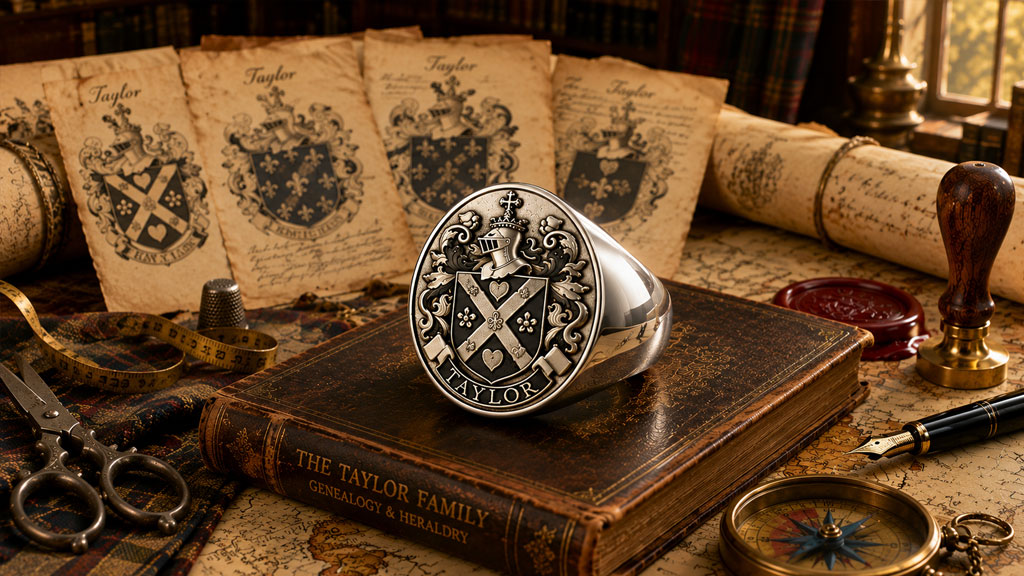
Taylor Family Crest Signet Rings are personalized heraldic rings featuring a Taylor-associated crest, coat of arms, clan badge, or custom family artwork. Since multiple Taylor family lineages exist, buyers should identify the appropriate design before selecting engraving style, ring shape, metal, and personalization.
A well-designed crest ring can become a meaningful family heirloom, milestone gift, or working wax-seal ring. However, its long-term value depends on more than appearance. The artwork must remain legible at jewelry scale, the engraving orientation must match its intended use, and the metal should fit the owner’s budget, lifestyle, and expectations.
This guide explains how to choose a Taylor heraldic design responsibly, compare engraving methods, select a ring face, evaluate metals, avoid common ordering mistakes, and create a personalized coat of arms ring worth preserving.
Taylor Family Crest Signet Rings at a Glance
| Decision | Main Options | Best Starting Point |
|---|---|---|
| Heraldic design | Researched design, supplied artwork, or custom interpretation | Use documented family information whenever possible |
| Engraving style | Raised Traditional, New Traditional, or Old Traditional | Choose according to display or wax-seal use |
| Ring face | Oval or Antique | Select the shape that best supports the artwork |
| Metal | Palisil, Questra, sterling silver, 10K, 14K, or 18K gold | Compare budget, wear, resizing, and heirloom value |
| Personalization | Names, initials, dates, mottos, or symbols | Prioritize details that will remain readable |
What this means: The heraldic design should come first. Afterward, the ring style, engraving method, and metal can be selected to support that design. Starting with the ring and forcing complex artwork into it often leads to crowded layouts or lost detail.
Explore Family Crest Ring Styles
Is There One Taylor Family Crest?
No single Taylor family crest belongs to every person who carries the surname. Historically, coats of arms and other armorial bearings were associated with particular individuals, families, locations, or branches rather than awarded universally to everyone with the same last name.
Consequently, two Taylor families may share a surname while having different ancestry, heraldic traditions, crests, shields, mottos, or complete heraldic achievements. A design associated with one documented Taylor branch should not automatically be presented as belonging to every Taylor family.
This distinction matters because online heraldic jewelry listings frequently display one attractive design as though it represents an entire surname. Although that design may be historically associated with a Taylor branch, a surname match alone does not establish a direct genealogical connection.
Buyers who value historical accuracy should compare the design with documented family information. Useful evidence may include ancestral locations, names, dates, genealogy records, an old family Bible, a written blazon, a wax seal, or photographs of an inherited ring.
In England, heraldic questions may be researched through historical records connected with the College of Arms. Scottish heraldry follows a separate legal and historical tradition associated with the Court of the Lord Lyon. These authorities reinforce the broader principle that coats of arms relate to specific lineages rather than surnames as a whole.
Some customers want a commemorative Taylor design rather than a claim of formal armorial inheritance. That approach can still produce meaningful custom signet jewelry. However, the design should be described honestly as Taylor-inspired, historically associated, or personally interpreted rather than presented as the universal Taylor coat of arms.
Expert insight: Responsible heraldic jewelry separates documented ancestry from surname symbolism. That distinction protects historical accuracy while still allowing families to create personal heirlooms.
What the Taylor Surname May Tell You
Taylor is widely recognized as an occupational surname connected with the work of a tailor. Its development is commonly linked to the Old French term tailleur, referring to a cutter or maker of clothing. Because occupational surnames developed independently in multiple places, the name could arise among families that were not closely related.
Taylor heritage may involve English, Scottish, Irish, Welsh, or later international family lines. Scottish searches may also produce the spelling Tailyour or references to clan associations. However, a clan connection, surname tradition, and personal coat of arms are not automatically the same thing.
For example, one family may historically associate with a Scottish clan while another Taylor line traces its ancestry to an English county and a separate heraldic tradition. Geographic history and documented relationships are therefore more useful than selecting a crest based only on surname spelling.
Common elements found in Taylor-related family heraldry may include shields, lions, tools associated with tailoring, crests, mantling, helmets, mottos, clan symbols, and other heraldic engraving details. Even so, none of these elements should be treated as belonging to every Taylor family.
How to Choose the Right Taylor Heraldic Design
The best design process depends on how much family information you already possess. First, determine whether you have verified artwork, partial genealogy, or only a general interest in Taylor heritage. Then choose the path that fits your situation.
You already have documented artwork. This is the strongest starting point. Suitable references may include a coat-of-arms illustration, written blazon, old seal, family document, pendant, engraving, or photograph of an inherited ring. Use the clearest and highest-resolution version available. A written blazon can also clarify colors, positions, and symbols that may be difficult to interpret from an aged image.
You have partial family information. Gather ancestor names, birthplaces, counties, countries, dates, and migration history. Ask relatives whether older family jewelry, documents, photographs, or seals still exist. These details may help narrow the search to a more plausible Taylor branch.
You want a commemorative Taylor design. A custom design can incorporate initials, dates, meaningful symbols, and historically inspired heraldic elements without claiming that one published coat of arms belongs to every Taylor. This is often the best option for families creating their first heirloom.
A common mistake is choosing the first crest found online because it looks impressive. Instead, verify the design or clearly frame it as commemorative. The strongest ring is one whose meaning the owner can explain with confidence.
Expert Tip: The most historically appropriate Taylor family crest ring is not necessarily based on the first design found online. Compare family records, ancestral locations, migration history, and documented heraldic references before selecting the artwork.
Raised, New Traditional and Old Traditional Engraving Compared
| Engraving Style | Appearance | Best For | Wax-Seal Result |
|---|---|---|---|
| Raised Traditional | The design rises above the ring face | Strong depth and sculptural detail | Not primarily designed as a traditional seal |
| New Traditional | The design is recessed and readable on the ring | Crisp everyday presentation | Creates a reversed wax impression |
| Old Traditional | The design is recessed in reverse orientation | Traditional wax-seal use | Creates a correctly oriented impression |
Raised Traditional engraving emphasizes dimension. The crest appears above the surrounding surface, producing a bold and sculptural presentation. It is an excellent choice when the visual depth of the shield, crest, mantling, or other heraldic elements is the main priority.
New Traditional engraving places the design into the surface while keeping it in the correct orientation for direct viewing. It offers crisp definition and is easy to understand when looking at the ring. However, pressing it into wax produces a reversed image.
Old Traditional engraving is cut in reverse. As a result, the ring may look backward when viewed directly, but it creates a correctly oriented impression in sealing wax. This is the appropriate choice for buyers who want a functional signet ring in the traditional sense.
Regardless of engraving style, extremely fine lines, long mottos, and crowded artwork may need to be simplified. Jewelry-scale engraving rewards clear shapes, balanced spacing, strong contrast, and separation between elements.
Which engraving makes a wax seal? Old Traditional engraving is designed for functional wax-seal use because the recessed design is cut in reverse and produces a correctly oriented impression.
Oval vs. Antique Ring Faces
An Oval face provides a classical signet-ring silhouette. Its vertical proportions often work well with shields, crests, helmets, escutcheons, and compact mottos. The smooth outline also creates a balanced appearance that suits both understated and elaborate heraldic designs.
An Antique face is more rectangular with softened corners. It can provide a broader architectural frame for bold shields, initials, horizontal design elements, or a more substantial engraved heraldic ring. Consequently, it often creates a heavier and more formal visual impression.
Neither face shape is automatically better. The artwork should determine the choice. A tall shield may fit naturally within an oval, while a wider heraldic achievement may benefit from an Antique face. The goal is to preserve proportion, engraving depth, and readability.
Which Metal Is Best for a Taylor Crest Ring?
| Metal | Best For | Main Consideration |
|---|---|---|
| Palisil | Affordable white-metal appearance | A durable non-precious alloy |
| Yellow Palisil | Occasional wear with a gold-colored finish | Gold plating requires realistic wear expectations |
| Black Palisil | Bold, modern gun-metal styling | Less traditional than silver or gold |
| Questra / 6K Gold | Budget-conscious buyers seeking a gold option | Lower gold content, with resizing capability |
| Sterling Silver | Classic precious-metal value | Requires periodic cleaning and care |
| 10K Gold | Durability and long-term wear | Lighter gold color than higher karats |
| 14K Gold | Balanced color, durability, and heirloom use | Higher investment than 10K gold |
| 18K Gold | Rich color and premium heirloom value | Softer and more expensive |
Palisil offers an affordable white-metal appearance and can work well for commemorative or budget-focused purchases. Black Palisil offers a contemporary gun-metal look. Yellow Palisil provides a gold-colored appearance, although buyers should understand that plated finishes may show wear differently from solid gold.
Questra, also described as a 6K gold option, provides a lower-cost path into gold and may be resized. It can suit buyers who want gold content and future sizing flexibility without moving immediately into 10K or 14K pricing.
Sterling silver is a traditional precious-metal choice with a bright finish and accessible price point. It may tarnish over time, but routine care can restore its appearance. It is often a strong entry-level choice for an heirloom-style crest ring.
For frequent wear, 10K gold offers durability and a more restrained gold color. Meanwhile, 14K gold balances color, durability, and long-term value. Finally, 18K gold provides a richer appearance and greater gold content, although it costs more and is somewhat softer.
Is sterling silver good for a family crest ring? Yes. Sterling silver offers traditional precious-metal value, bright color, and a lower entry price than gold. It requires periodic care but can be an excellent choice for a personalized family crest ring.
Best-fit summary: Choose Palisil for affordability, sterling silver for classic precious-metal value, 10K gold for durability, 14K gold for balance, and 18K gold for premium color and heirloom positioning. Consider future resizing before making the final decision.
Dunham Jewelry Manufacturing, Inc. offers multiple clearly identified metal options and alloys its gold in-house from high-purity gold. Each ring is manufactured and finished individually in the United States rather than purchased as generic inventory from an outside reseller.
Quick Buying Recommendations
| If You Want | Recommended Choice |
|---|---|
| Maximum sculptural depth | Raised Traditional engraving |
| A functional traditional wax seal | Old Traditional engraving |
| A directly readable recessed design | New Traditional engraving |
| A classical vertical ring face | Oval style |
| A broader, more substantial face | Antique style |
| An affordable non-precious option | Palisil |
| Entry-level precious metal | Sterling silver |
| Durable gold for frequent wear | 10K gold |
| A balance of color and durability | 14K gold |
| Premium gold color and heirloom positioning | 18K gold |
What Can Be Customized?
A Taylor family crest signet ring can be personalized well beyond the central shield or crest. Depending on the ring style, buyers may add initials, names, dates, mottos, memorial wording, side-panel artwork, ancestral locations, occupations, military symbols, school emblems, or other meaningful details.
However, more customization does not always produce a better ring. Because a signet face has limited space, every additional line or symbol competes for attention. The most important elements should therefore receive visual priority. A clear shield, recognizable crest, and short motto will usually reproduce more successfully than a crowded design containing numerous small details.
Customer-supplied artwork may also need to be adapted. Thin lines can be strengthened, overlapping elements can be separated, and tiny text can be enlarged or removed. These changes are not intended to alter the family symbolism. Instead, they help the heraldic engraving remain legible and structurally sound at jewelry scale.
Interior engraving offers another way to preserve private information without crowding the face. A name, anniversary date, family phrase, or dedication can be placed inside the band while the exterior remains visually balanced.
Who Taylor Family Crest Signet Rings Are Best For
Taylor family crest signet rings are especially well suited to people who value genealogy, personalized craftsmanship, and long-term meaning. They can mark a family discovery, commemorate a milestone, replace a lost heirloom, or create a tradition that did not previously exist.
For example, a parent may present a Taylor crest ring at graduation, while siblings may order coordinated designs for a family reunion. A spouse may choose one as an anniversary gift, or a genealogy enthusiast may commission a ring after identifying a documented family branch.
These rings also work well as retirement, birthday, wedding, memorial, and heritage gifts. An Old Traditional design can additionally serve a functional purpose for buyers who want to create wax impressions for letters, certificates, invitations, or personal stationery.
Best fit: This type of ring is most valuable to someone who understands the story behind the design and expects to keep, wear, or pass down the finished piece.
When This Type of Ring May Not Be Ideal
A custom crest ring may not be the right choice for someone who needs an immediate, mass-produced item with no design-review process. Custom artwork, engraving preparation, manufacturing, and hand finishing require more planning than purchasing a standard fashion ring from existing inventory.
It may also be unsuitable when the buyer expects a plated or non-precious finish to behave exactly like solid gold during years of heavy daily wear. Although affordable alloys can provide excellent appearance and value, their long-term expectations should match the selected material.
Buyers with uncertain ring sizes should avoid rushing into metals or designs that may be difficult to resize. Extremely detailed artwork may also require simplification. Anyone unwilling to adapt a complex illustration for legibility may therefore be disappointed by the limitations of a jewelry-sized surface.
Finally, a crest ring should not be purchased as proof that a particular coat of arms belongs to every Taylor family. When historical entitlement matters, genealogy research should come before the final design decision.
Common Buyer Mistakes
- Assuming one crest belongs to every Taylor. Multiple unrelated families may share the surname. A displayed design should therefore be researched or described responsibly.
- Choosing appearance before family history. An attractive crest is not necessarily connected to the buyer’s ancestry.
- Ordering the wrong engraving orientation. New Traditional is readable on the ring, while Old Traditional is reversed to create a correctly oriented wax impression.
- Submitting poor artwork. Blurry screenshots and heavily compressed images can hide important lines or symbols.
- Including too much information. Long mottos, multiple dates, and numerous symbols can reduce clarity.
- Ignoring the face shape. Artwork that fits an oval may not fit an Antique face equally well.
- Selecting metal only by color. Durability, maintenance, resizing, gold content, and long-term value also matter.
- Guessing the ring size. A custom ring should be sized carefully before production.
- Waiting until the last minute. Personalized manufacturing requires adequate time, particularly before weddings, graduations, reunions, or holidays.
- Comparing price without comparing construction. Two rings may look similar online while differing significantly in metal, weight, engraving depth, finishing, warranty, and manufacturing origin.
Direct Manufacturer vs. Jewelry Reseller
| Buying Factor | Direct Manufacturer | Reseller or Marketplace Seller |
|---|---|---|
| Design control | Greater ability to adapt custom artwork | Often limited to listed templates |
| Communication | Questions can reach the production source | Information may pass through a third party |
| Material transparency | Manufacturer can explain alloys and construction | Details may depend on an outside supplier |
| Customization | More flexible when production is handled in-house | Usually restricted to available configurations |
| Accountability | One company controls the manufacturing process | Responsibility may be divided among sellers and suppliers |
| Future service | Manufacturer may be better positioned to evaluate its own work | Repair and warranty support vary by seller |
Buying directly from a manufacturer can provide more visibility into how a ring is made. Customers can ask about artwork preparation, metal composition, engraving depth, finishing, sizing, and warranty service without relying entirely on information supplied by a third-party retailer.
In contrast, some resellers and marketplace sellers provide convenient ordering and competitive advertised prices. However, the actual manufacturing source may be unclear, and customization may be limited to changing initials, selecting a finish, or choosing from a fixed set of designs.
Why Manufacturing Matters
Many online jewelry sellers purchase finished rings from outside suppliers. By contrast, Dunham Jewelry Manufacturing, Inc. manufactures and finishes each ring individually in the United States.
Direct manufacturing provides greater control over heraldic engraving, artwork adaptation, metal selection, structural quality, polishing, inspection, and customization. It also gives customers a clearer source of accountability when questions arise before or after the sale.
Because Dunham controls the manufacturing process, the company can offer multiple metal choices, deeper personalization, direct production knowledge, and a Lifetime Warranty rather than relying entirely on the policies of an outside factory.
Cost and Long-Term Value
The cost of a Taylor family crest ring depends on several variables rather than the surname itself. Metal selection is usually one of the largest factors. Ring size, metal weight, face dimensions, engraving style, artwork complexity, side personalization, stones, and finishing requirements can also affect the final price.
An affordable alloy may be appropriate for occasional wear, a first family ring, or a buyer focused primarily on appearance. Sterling silver offers a traditional precious-metal option at a more accessible price than gold. Meanwhile, 10K, 14K, and 18K gold serve buyers who place greater emphasis on gold content, long-term value, and heirloom use.
The lowest initial price is not always the lowest lifetime cost. A ring with unclear material information, shallow engraving, limited service, or no meaningful warranty may need replacement sooner. Buyers should therefore compare what is included rather than comparing advertised prices alone.
Why this matters: Long-term value comes from the relationship between meaning, materials, craftsmanship, service, and wear expectations. A less expensive ring can be an excellent choice when it matches the intended use. Paying more for gold or deeper customization makes sense only when those benefits matter to the owner.
Are Taylor Family Crest Signet Rings Worth It?
A Taylor family crest signet ring can be worth the investment when its design has personal meaning, the heraldry is represented responsibly, and the materials match the owner’s expectations. Unlike ordinary fashion jewelry, a custom crest ring can preserve family history, commemorate an achievement, or become an heirloom passed to another generation.
Its value may also be practical. An Old Traditional ring can create wax impressions, while a normally oriented design can serve as a visible personal emblem. Custom engraving also allows the buyer to include information that cannot be found in a standard retail ring.
On the other hand, it may not be worth purchasing a costly ring simply because a generic surname crest appears online. The strongest value comes from understanding the design, choosing suitable materials, and ordering a ring that will actually be worn or preserved.
Bottom line: A family crest ring is worth it when the story, construction, and intended use justify the purchase—not merely because the design looks impressive.
What to Know Before Ordering
- Identify the Taylor family branch or decide to create a commemorative design.
- Gather the clearest artwork, photographs, records, or written descriptions available.
- Choose whether the ring is intended for direct viewing or wax-seal use.
- Select an Oval or Antique face based on the artwork’s proportions.
- Compare metals according to budget, wear, maintenance, resizing, and heirloom goals.
- Confirm the ring size rather than estimating.
- Limit text and symbols to details that will remain readable.
- Verify the spelling of names, dates, initials, and mottos.
- Review manufacturing and delivery expectations before a fixed gift date.
- Understand the warranty and future service options.
- Keep a copy of the approved artwork and personalization details.
This checklist prevents most avoidable ordering problems. It reduces the risk of incorrect artwork, reversed engraving, unreadable details, poor metal selection, and sizing mistakes.
How the Custom Ordering Process Works
- Choose a ring style. Begin with the Oval or Antique collection and select the face that best fits the design.
- Select the engraving method. Choose Raised Traditional, New Traditional, or Old Traditional according to the desired appearance and function.
- Select the metal. Compare Palisil, Questra, sterling silver, and available karat-gold options.
- Select or submit artwork. Use an available Taylor-associated design or provide documented family artwork for custom interpretation.
- Add personalization. Include initials, names, dates, mottos, side symbols, or interior engraving where appropriate.
- Confirm ring size. Use an accurate sizing method before the ring enters production.
- Review every detail. Double-check spelling, dates, engraving orientation, metal, and design choices.
- Complete the order. Contact Dunham Jewelry when additional design or ordering assistance is needed.
Dunham Jewelry Manufacturing, Inc.
822 Southwestern Dr.
El Paso, TX 79912
1-915-845-1722
Start Designing Your Taylor Family Crest Ring
Why Choose Dunham Jewelry Manufacturing, Inc.?
Dunham Jewelry Manufacturing, Inc. is a direct jewelry manufacturer rather than a retailer purchasing finished rings from an outside source. The company therefore maintains control over design preparation, manufacturing, metal selection, engraving, finishing, inspection, and customer service.
Every custom ring is manufactured and finished individually in the United States. This approach supports sharper engraving, stronger structural quality, cleaner finishing, and greater flexibility when a customer submits unique artwork or requests meaningful personalization.
Dunham also provides transparent metal options, including Palisil, Questra, sterling silver, and 10K, 14K, or 18K gold. Gold is sourced in a highly pure form and alloyed in-house to meet the required karat standard. Customers consequently receive clearer information about what they are purchasing.
With more than 30 years in business and over 100 years of combined custom-jewelry manufacturing experience, Dunham brings practical knowledge to complex personalized designs. Every ring is also backed by a Lifetime Warranty.
Create a Taylor Ring Worth Passing Down
A meaningful Taylor family crest ring begins with a responsible design choice. First, determine whether the artwork represents a documented family branch or a commemorative interpretation. Next, choose an engraving method that matches the intended appearance or wax-seal function. Finally, select a face shape and metal that fit the artwork, budget, wear, and long-term goals.
When the design is clear, the materials are honestly described, and the craftsmanship supports daily wear, a signet ring can become more than an accessory. It can preserve a family story and create an heirloom worth keeping for life.
Start Designing Your Custom Taylor Family Crest Signet Ring
For assistance selecting a crest, engraving style, face shape, or metal, call Dunham Jewelry Manufacturing, Inc. at 1-915-845-1722.
Frequently Asked Questions
Does every Taylor family have the same crest?
No. Multiple Taylor families and heraldic branches exist. One coat of arms should therefore not be presented as belonging automatically to every person with the surname. When historical accuracy matters, compare the design with genealogy records, ancestral locations, or verified family artwork.
Which Taylor family crest belongs to my family?
The answer depends on your documented ancestry rather than the surname alone. Begin with ancestor names, geographic locations, dates, family records, old jewelry, seals, or a written heraldic blazon. When the connection cannot be verified, a commemorative Taylor-inspired design may be more appropriate.
Can I submit my own Taylor coat of arms?
Yes. Customer-supplied artwork, photographs, seals, blazons, documents, and images of inherited rings can be reviewed for custom engraving. The artwork may need to be simplified or redrawn so important details remain clear at jewelry scale.
Can I use my grandfather’s coat of arms?
An inherited design, ring, seal, or family document can provide a valuable starting point. Its connection to your family should still be documented when historical accuracy matters. Clear photographs and supporting family information can help with interpretation and recreation.
What if I do not know which Taylor crest is mine?
Begin with known ancestors, locations, dates, and family records. Alternatively, you may create a Taylor-inspired commemorative design using initials, dates, and meaningful symbols without claiming that a specific historical coat of arms belongs to every Taylor family.
Which engraving is best for a wax seal?
Old Traditional engraving is the correct choice for a functional wax-seal ring. The design is engraved in reverse so the wax impression appears in the proper orientation. New Traditional engraving is readable on the ring but produces a reversed seal.
What is the difference between Oval and Antique styles?
Oval styles have a fully oval face and offer a classical signet-ring appearance. Antique styles are more rectangular with rounded corners. The best option depends on the width, height, and arrangement of the heraldic artwork.
Which metal is best for daily wear?
The best choice depends on budget and care expectations. Sterling silver offers classic precious-metal value, while 10K gold is often selected for durability. Meanwhile, 14K gold balances color and strength, and Palisil provides a lower-cost non-precious alternative.
What is the best gold for a signet ring?
10K gold is often selected for durability, 14K gold offers a strong balance of color and wear resistance, and 18K gold provides richer color and greater gold content. The best choice depends on budget, wear habits, and heirloom expectations.
Can a Taylor crest ring be resized?
Resizing depends on the metal, ring structure, design, and amount of adjustment required. Questra and traditional gold options may provide resizing possibilities. Buyers should still confirm size carefully before production rather than relying on future alteration.
Can women wear Taylor family crest rings?
Yes. Family crest rings are not limited to one gender. Face size, band proportions, metal, finish, and personalization can be selected according to the wearer’s hand, comfort, and style preferences.
Can an old family ring be recreated?
In many cases, photographs, sketches, wax impressions, or the original damaged ring can provide a starting point. The design may require interpretation when details are worn or missing, so the clearest references available should be submitted.
How much does a custom Taylor crest ring cost?
Cost varies according to metal, ring size, weight, face style, engraving method, artwork complexity, side customization, stones, and finishing. Buyers should configure the desired ring or contact Dunham Jewelry for guidance based on their specific design.
Still unsure which Taylor heraldic design fits your family?
Contact Dunham Jewelry Manufacturing, Inc. for help comparing artwork, engraving formats, ring shapes, metals, and personalization options before placing your order.